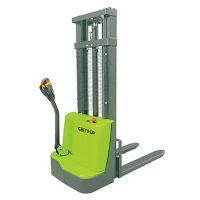

For regional warehouse equipment wholesalers across the EU and the UK, importing standard manual hand pallet trucks from China used to be a straightforward, high-volume margin builder. That equation broke when European Commission anti-dumping duties-reaching up to 70.8% depending on the exporter-hit Chinese-origin manual pallet trucks and their essential parts.
Many distributors tried absorbing the tariff hike or sourcing from secondary Asian assembly hubs, only to run into inconsistent steel gauges, delayed lead times, and shrinking dealer margins. Meanwhile, an entirely different shift has been happening on warehouse floors from Rotterdam to Warsaw: end-users are retiring manual jacks in favor of compact, entry-level lithium-ion pallet trucks.
Because electric pallet trucks fall under a separate customs classification (HS Code 8427.10) outside the scope of the manual pallet truck anti-dumping measures, pivoting your catalog toward entry-level electric units solves two problems at once. It eliminates punitive import duties while giving your sales team a higher-ticket, faster-moving product line.
The Landed Cost Reality: Tariff-Hit Manual Jacks vs. Entry-Level Lithium Units
When you factor in anti-dumping duties, port handling, and inland freight, the landed cost gap between a heavy-duty manual pallet jack and a 1.5-ton pedestrian lithium electric pallet truck narrows dramatically.
End-users in retail backrooms, light manufacturing, and 3PL cross-docking facilities are increasingly willing to pay a modest premium over a manual jack once they calculate operator fatigue and turnover. A single worker pushing 1,200 kg pallets across a concrete floor for an eight-hour shift loses roughly 25% to 30% of their handling speed by mid-afternoon. A compact electric unit maintains uniform travel speed from 8:00 AM to 5:00 PM.
| Commercial & Operational Factor | Tariff-Impacted Manual Pallet Truck | Entry-Level Lithium Electric Pallet Truck (1.5T–2.0T) |
| EU Anti-Dumping Duty Exposure | High (Subject to punitive tariffs on manual units/parts) | Exempt (Classified under self-propelled electric trucks) |
| Distributor Gross Margin Potential | Compressed by tariff pass-through resistance | Higher unit margin + recurring spare parts/battery revenue |
| Chassis Footprint & Turning Radius | ~1,150 mm fork length; compact | Nearly identical chassis length; fits inside standard HGVs & tail lifts |
| Power & Charging Infrastructure | None | Removable 24V/48V lithium pack; plugs into standard 230V EU wall outlet |
| End-User Shift Productivity | Drops sharply on ramps, dock plates, and long runs | Consistent electric drive and lift; handles 5%–8% gradients loaded |
Why Entry-Level Lithium Models Replace Manual Jacks Seamlessly
Historically, European buyers hesitated to stock electric pallet trucks for small-to-midsize accounts because traditional lead-acid models were bulky, required dedicated charging bays, and demanded weekly distilled water maintenance. Modern lithium-ion battery pallet trucks remove those barriers entirely:
- Drop-In Plug-and-Play Charging: With removable lithium battery packs and external chargers fitted with standard EU Type C/F or UK Type G plugs, warehouses do not need three-phase industrial charging stations. Operators can swap a depleted pack in 15 seconds or opportunity-charge during a 30-minute lunch break.
- Tail-Lift and Lorry Compatibility: Entry-level 1.5-ton pedestrian units weigh roughly 120 kg to 145 kg-light enough to ride on standard commercial delivery tail lifts without eating into payload capacity.
- Lower Warranty Claim Rates: Brushless DC drive motors and integrated Curtis or Zapi controllers eliminate carbon brush replacements and simplify fault diagnostics for your local service technicians.
What European Importers Must Verify Before Placing an Order
Transitioning your inventory from manual to electric equipment carries compliance risks if your factory treats export documentation as an afterthought. Customs authorities in Antwerp, Hamburg, and Felixstowe routinely hold containers when technical files are incomplete.
Before committing to a supplier, verify three non-negotiables:
- Authentic CE Machinery Directive Compliance: Ensure the factory provides a valid Declaration of Conformity (DoC) aligned with EN ISO 3691-1 (industrial trucks safety requirements) and EMC directives-not a generic certificate issued by an unaccredited testing agency.
- UN38.3 and MSDS Lithium Certification: Maritime carriers and EU customs require verified UN38.3 test summaries and Material Safety Data Sheets for every lithium battery pack shipped inside or alongside the chassis.
- Flexible Trial MOQs for Mixed Containers: You should not have to gamble on a full 40HQ container of a single unproven SKU. Working with an experienced OEM warehouse equipment manufacturer allows you to consolidate 1.5T and 2.0T electric pallet jacks alongside electric stackers or specialty stainless steel units in one mixed shipment.
Protecting Your Local Territory as a Regional Distributor
One common frustration among regional European wholesalers is investing months into marketing a supplier's equipment, only to see that same factory undercut them by selling directly to local end-users or exhibiting at regional trade fairs.
At Carryup, 99% of our export volume is built on long-term OEM and private-label partnerships. We do not compete against our distributors at local regional expos, and we support your brand equity with custom RAL powder-coating, private-label decals, multilingual safety labels, and guaranteed spare parts availability. You can review our standard shipping configurations, battery warranty terms, and MOQ policies directly on our distributor FAQ page.
Ready to calculate your landed margins on tariff-free electric units?
Request our 2026 European Electric Pallet Truck CE Compliance & OEM Catalog-complete with FOB pricing, container loading specs, and sample Declaration of Conformity files.