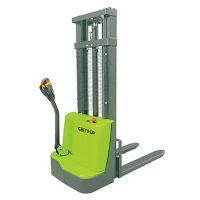

If you've ever walked through a tight warehouse aisle stacked high with pallets or watched a team shuffle long steel pipes down a narrow storage bay, you've probably seen a three way electric reach truck at work. These things are total workhorses, but one question I get from new warehouse managers, forklift operators, and even other equipment suppliers all the time is: "What's the max load capacity of a three way electric reach truck anyway?" It's not a one-size-fits-all number, right? I'm gonna break this down like I explain it to my regulars, no jargon, no fancy textbook stuff-just the real, practical deal, plus how that lines up with what we build here, and why it matters for your space.
First, let's cut to the basics: a three way electric reach truck is different from the regular forklifts most folks know. Regular counterbalance trucks (you can check out a similar utility here if you're curious about other electric warehouse equipment) have those big weights on the back to balance heavy loads. A three way truck? It's built to pivot its mast sideways-like, 90 degrees either way-so you don't have to turn the whole truck around to pick up and place long, awkward loads like lumber, steel bars, or even extra-long pallets. That's why they're the go-to for super narrow aisle (NA) warehouses, where every inch of space counts. But that sideways pivot and compact frame? Those are tied straight to their load limits.
Now, the max capacity isn't just a random number stamped on the side. It's a number engineered around three main things: the truck's design, how high you're lifting that load, and where the load actually sits. Let's start with the design itself. At our shop, the three way electric reach trucks we manufacture have a standard max load capacity of around 3,000 to 5,500 pounds-but that's only when you're lifting close to the ground, like 10 feet or less. Push that lift height up to 25 feet, and that number drops fast, sometimes by 1,000 pounds or more. Why? Taller lifts mean the mast stretches out more, which shifts the truck's center of gravity. Imagine holding a 5-pound dumbbell straight out at shoulder height versus holding it at your side-way more strain on your arm, right? Same logic here: the higher you reach, the less weight the truck can safely handle without tipping.
There are other factors too, like battery type and tire configuration. Our 4 wheels electric forklift trucks, for example, have a wider base that lets them carry heavier loads at taller heights, but the three way's narrow frame is optimized for aisles as tight as 6 feet, not heavy lifting. That tradeoff is key-you don't buy a three way truck to move super heavy stuff (like 8,000-pound pallets of concrete blocks) or lift 30 feet; you buy it to fit into aisles where a regular forklift can't squeeze at all.
Another thing I get asked a lot: how does a three way truck compare to other electric lift options? Let's think about the seat type electric reach truck (another one of our models) which is similar in function but built for slightly different use cases. The seat type model has a more stable base for lifting heavier loads at medium heights, so its max is a bit higher than the stand-up three way, which is what most warehouses use for ultra-narrow aisles. If you're moving long loads that don't need a pivot, you might even look at an electric side load forklift, which is built specifically for horizontal loads but can't lift as high as a three way. And for smaller, lighter loads in tighter spaces? A counterbalanced electric stacker works great, but it's not designed for the high lifts that three way trucks handle.
Wait, let's get specific with real numbers, because vague "3,000 to 5,500 pounds" only goes so far. Here's what we see with the models we build day to day: The entry-level three way truck, used for small warehouses with aisles around 6 feet wide, has a max load of 3,000 pounds when lifting 12 feet. If you crank that lift to 20 feet, that drops to 2,200 pounds. The mid-tier model, which most medium warehouses use, hits 4,000 pounds at 15 feet, and 2,800 pounds at 25 feet. Our heavy-duty three way is the big one-5,500 pounds at ground level, 3,500 pounds at 20 feet. That's the one for warehouses storing extra-tall pallets of goods, like consumer electronics or canned goods that stack high.
But before you run out and buy the 5,500-pound model, there's a catch: load capacity also depends on the load's center of gravity. What's that? It's the point where the load's weight is concentrated. If you're picking up a standard 48x40-inch pallet, the center of gravity is usually 24 inches from the forks. If you're stacking an irregular load-like a pile of boxes that stick out past the pallet edges, making the center of gravity shift 30 inches back-your max capacity drops by another 500 pounds, easy. We always tell our customers: measure your load's center of gravity, not just its total weight, when choosing a truck. A 5,000-pound load on a standard pallet is way different than a 5,000-pound load that's sticking out extra far.
Also, don't forget about the aisle width. Three way trucks need a super narrow aisle to work, but that compact size that lets them fit also limits their weight capacity. A regular counterbalance forklift (you can learn more about that style here) has a wider base, so it can carry up to 5,000 pounds at 15 feet, but it needs an aisle 10 feet wide or more. So if your warehouse only has 7-foot aisles, you can't use that counterbalance model-you have to go three way, and that means accepting that your max load is going to be a bit lower. It's all tradeoffs, right? You're saving space, so you sacrifice a little lifting power.
Now, why does this matter for your business? Let's say you're running a e-commerce warehouse, and you're trying to fit 10,000 more pallets into the same space. Switching from counterbalance trucks to three way lets you cut aisle width by 40%, but you have to make sure the three way's capacity is enough for your pallets. If your pallets weigh 3,200 pounds, our entry-level three way at 3,000 pounds is too small-you need the mid-tier 4,000-pound model, even if it's a little more expensive. Crutching it with an overloaded truck is a quick way to get a safety hazard, not to mention damage to your forklift. We've seen that happen too many times: a customer buys a cheaper entry model, overloads it a couple times, and ends up with a broken mast and a $2,000 repair bill, plus downtime for their warehouse.


Wait, let's also talk about misuse. A lot of new operators see the max capacity on the sticker and think that's the number they can always use, no matter the lift height. That's a mistake. We always train our customers' teams: check the load capacity chart for your specific truck every time you pick up a load. It's usually on the inside of the truck's cab or the door, and it will list capacity for every lift height. For example, our heavy-duty three way's chart will say 5,500 lbs at 0 ft, 4,800 lbs at 10 ft, 3,500 lbs at 20 ft. If someone tries to lift a 4,000-pound load at 20 feet, that's a tip waiting to happen. And tips are not just bad for your truck-they're dangerous for your operators, which can lead to worker's comp claims and OSHA fines.
Another point: electric vs. gas? Our three way electric reach trucks are the most popular for indoor warehouses, because gas models fume, which is a no-go in closed spaces. But the electric power source also affects capacity. If you use a old, worn-out battery, it might not give the truck enough power to handle the full max load at tall heights. We recommend replacing your battery every 3-5 years, depending on use, to keep your capacity where it should be. We also sell replacement batteries, so if you notice your truck struggling to lift heavy loads, that's one of the first things we check.
Let's circle back to the original question: what's the max load capacity? It's not a single number-it's a range, tied to design, lift height, load size, and even your warehouse's layout. For three way electric reach trucks, the sweet spot is about 3,000 to 5,500 pounds, but that's at ground level. For high lifts, that drops to 2,200 to 3,500 pounds. The trick is matching that number to your specific needs: how tall do you lift, what do you move, and how narrow are your aisles?
If you're in the market for a three way electric reach truck (or any other electric warehouse equipment, for that matter) and you're not sure which capacity is right for your space, don't guess. We're here to help. We've worked with hundreds of warehouses, from small 10,000 sq ft operations to huge distribution centers with 50,000 sq ft of narrow aisles. We can walk you through your layout, your load sizes, and your lift heights, and help you pick the truck that gives you the right balance of space savings and load power. No pushy sales talk, just straight answers. If you're tired of forklifts that don't fit your aisles or can't handle your loads, reach out to our team today to talk through your needs.