
If you've ever spent time in a warehouse, stock room, or even a small retail storage space, you've probably seen a manual stacker whizzing (or slowly trundling) around, lifting pallets of inventory to get them onto shelves or rearrange stock. But if you've ever stopped to count its wheels, you're not alone-this is one of the first questions new buyers, warehouse managers, even part-time workers ask when shopping for their first stacker. As a manual stacker supplier, I get dozens of emails a week asking about wheel count, and it's not just random curiosity: the number of wheels directly impacts how the machine handles tight spaces, heavy loads, and uneven warehouse floors. So let's break this down, no jargon, just real-world facts based on the stackers we sell every day.
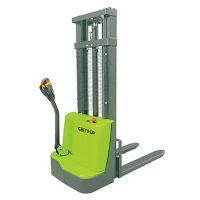
First, let's start with the basics: most standard manual stackers you'll see on a worksite have four wheels. Wait, before you go "that's too simple," there's a reason for that, and it's not just a random design choice. Let's split the wheels into two groups to make it easy: the load-bearing wheels at the front (the ones that support the pallet and lift the weight) and the steering wheels at the back (the ones that let you turn the stacker without tipping it over).
The two front wheels are the workhorses here. They're bigger, thicker, and built to handle the full weight of the load-we're talking 1.5 ton or 2 ton loads, right? Those front wheels need to distribute that weight evenly, so the frame doesn't bend or the wheels get stuck on cracks in the warehouse floor. Then you have two rear wheels, which are smaller, usually made of durable rubber or polyurethane, specifically for steering. That four-wheel set-up might feel basic, but it's been tested over and over for decades because it balances stability and maneuverability. If you tried a three-wheel design, the load would put way too much pressure on two wheels, making them wear out fast, and the stacker would tip more easily when turning-total headache for anyone using it 8 hours a day.
But wait, not all manual stackers are the same. That four-wheel rule isn't universal, and that's where you'll see variations depending on what the stacker's designed to do. Let's talk about the types of stackers we sell, because that's where most people get confused about wheel count. For example, a scissor high-lift manual stacker-if you've never used one, it lifts pallets way higher than a standard stacker, sometimes up to 10 feet for tall shelves. I know when I first started helping customers choose one, I thought it'd have more wheels to support the extra height, but nope, it still has four wheels. Wait, let me confirm that: yeah, scissor lifts have the same four-wheel set-up because scissor arms already add stability when the load is lifted high. The only difference is the front wheels might be a little wider to handle the extra strain of lifting higher, but you're still looking at two front load wheels and two rear steering wheels. That's good to know if you're working with high shelves in a small warehouse-you don't need a totally different wheel set, just a model with the right lift height.
Then there are specialty stackers, like the drum stacker YTD-35, which is built specifically for moving and lifting 55-gallon drums full of chemicals, food ingredients, or whatever. Those aren't your standard pallet stackers, so their wheel count changes to fit their job. I get a lot of questions about drum stackers, and people always ask, "why does this one have five wheels?" Let me explain: the drum stacker's design is different because you're not supporting a flat pallet-you're cradling a round, top-heavy drum. That extra wheel (usually a small caster at the front center) adds extra stability so the drum doesn't tip while you're lifting it. It might feel like overkill, but if you've ever had a 500-pound drum wobble, you know that stability isn't something to cut corners on. That five-wheel design lets you move the drum smoothly without having to balance it yourself, which is a huge safety win for anyone working with heavy liquids or materials.
Another common variation: galvanized manual stackers. We sell a lot of these for warehouses in food processing, pharmaceuticals, or places that need to wash their equipment regularly. Galvanized means the frame and parts are coated with zinc to resist rust, which is perfect for cleaning, but what about wheels? Most galvanized stackers still use four wheels, but sometimes the rear steering wheels are made of a food-grade material so they don't shed any particles when rolling over a clean floor. The wheel count doesn't change for galvanized models, just the material of the wheels to fit the environment.
Wait, let's circle back to the standard 1.5 ton manual stacker and 2 ton manual stacker that we sell-those are two of our best-sellers, and their wheel count is almost always four. The only time you'll see a different number there is if you're looking at a "narrow aisle" model, which is made for super tight spaces, like between shelves that are only 3 feet apart. Narrow aisle stackers sometimes have two rear wheels instead of four? No, wait, no-let me get that straight. Narrow aisle models still have four wheels, but the rear steering wheels are in a different arrangement, or the front wheels are spaced closer together to turn more tightly. You might see someone mix up "number of wheels" with "wheel placement," but even narrow aisle 1.5 ton stackers don't have fewer wheels-they just have a design that lets them spin in a smaller circle without tipping.
Now, why does this wheel count stuff matter, aside from just picking a stacker? Let's be real: if you buy a stacker with the wrong wheel count, you'll end up dealing with problems way bigger than counting wheels. For example, if you're a small business with a retail storage space, and you get a three-wheel stacker because it seems "easier to turn," you'll notice the front wheels wearing out in 6 months instead of 2 years because they're carrying all the weight. Or if you're moving heavy drums and get a four-wheel drum stacker, you'll spend twice as much time readjusting the drum because it tips more easily. That's why as a supplier, we don't just tell customers "four wheels" or "five wheels"-we ask them what they're using the stacker for, how much space they have, and how heavy their loads are, to match the right model.
I've seen this first-hand with a local bakery that came to us last year. They needed a stacker to move 50-pound bags of flour and sugar, and they had a really small back storage area. They initially asked for a three-wheel stacker because they thought it would be more maneuverable. But when we walked them through it, we told them our 1.5 ton manual stacker (four wheels) would work better for their heavy bags, and the narrow aisle version of it would fit in their tight spaces. They ended up buying it, and a month later they emailed us saying it was way better than the three-wheel model they had considered before-no tipping, the wheels haven't worn out, and it turns just fine in their small aisles. That's the stuff that makes this job worth it, not just selling a product, but helping someone pick the right one.
Another example: a chemical warehouse we supply got a drum stacker YTD-35 last quarter. They were worried at first about the five-wheel design, thinking it would be harder to clean around, but after using it for a week, they said the extra wheel made moving 55-gallon drums way safer. Before that, their workers had to balance the drums while lifting, which was a safety hazard-now they just roll the stacker under the drum, lift it, and move it, no balancing needed. That's exactly why specialty stackers have different wheel counts: they're built for a specific job, not general use.
Let's also talk about wheel maintenance, because even if you get the right number of wheels, you need to take care of them. For standard four-wheel stackers, check the front load wheels every month to make sure they're not flat or worn down, and the rear steering wheels to make sure they turn freely. For the drum stacker's extra front wheel, you'll want to clean around it more often because it's low to the ground, so dust or debris doesn't get stuck and make it hard to turn. If you ignore wheel maintenance, even the best stacker will stop working fast, and that'll cost you time and money.


Wait, let's clear up a common misconception: some people think more wheels mean more stability, but that's not always true. A standard four-wheel stacker is already super stable for most loads-adding more wheels (like a six-wheel model) usually only makes sense for really heavy industrial use, like lifting 5 ton loads, and even then, those are less common for manual stackers. Manual stackers are designed to be operated by one person, so they can't be too heavy or too bulky, so most stick to four wheels for general use, and five for specialty drum models.
If you're in the market for a manual stacker, don't stress too much about the wheel count at first. Start with what you need it for: are you moving standard pallets? Then look at our 1.5 ton manual stacker or 2 ton manual stacker-both have four wheels, built for regular pallet work. Do you need to lift pallets high for tall shelves? The scissor high-lift manual stacker is your guy, still four wheels, just higher lift. Do you work with drums? The drum stacker YTD-35 has the five-wheel design built just for that. And if you need rust resistance for food or medical use, check out our galvanized manual stacker, which has four wheels made for clean environments.
I always tell customers that when in doubt, reach out to us. We're not just a supplier who sends you a box and disappears-we help you figure out the right stacker, the right wheel set-up, even how to maintain it. A stacker is a big investment for a small business or a warehouse, so you don't want to get it wrong. Whether you're a warehouse manager with 10 workers, a small retail owner with a single storage closet, or someone who just needs a stacker for occasional use, the wheel count is a small part of the puzzle, but it's an important one. It's not just about how many wheels there are, it's about what those wheels are designed to do, based on your needs.
At the end of the day, the most important thing is that your manual stacker works for you, not against you. Too many people get stuck on "four wheels is standard" and don't think about their specific use case, or get tricked into buying a model with more wheels than they need, which just adds unnecessary cost. That's why we break it down for every customer: walk through their space, their load weight, what they're moving, and then point them to the right model, whether it's a four-wheel standard stacker, a four-wheel scissor lift, or the five-wheel drum stacker. If you're ready to find the right manual stacker for your needs, feel free to get in touch to discuss your requirements.