
Anyone who has sourced material handling equipment from China knows the hidden trap behind ultra-low FOB quotes: the assembly-shop model.
Across industrial hubs in Zhejiang and Jiangsu, dozens of trading companies and small workshops buy stamped forks from one vendor, off-the-shelf hydraulic pumps from a second, and cast wheels from a third. They bolt the pieces together, spray on a glossy coat of paint, and ship the container. Six months later, when those pallet jacks hit your customers' warehouse floors, hydraulic seals blow out under rated loads, fork tips twist on uneven dock plates, and your service team eats the margin in warranty replacements.
When you are building a regional distribution business or a private-label hardware line, your reputation rests on metal fatigue limits and hydraulic tolerances-not brochure specs. That is why Carryup has spent over four decades (since 1983) keeping 99% of core component manufacturing in-house.
What "99% In-House Manufacturing" Actually Looks Like on the Shop Floor
Outsourcing core sub-assemblies saves a factory upfront capital, but it destroys batch-to-batch consistency. If a third-party pump supplier changes an O-ring vendor to save three cents per unit, the assembler won't notice until containers are already at sea.
At our manufacturing base, supported by an engineering team of more than 50 specialists, raw steel enters one end of the facility and finished, load-tested equipment rolls out the other. Walking through our production process, three critical stages separate true OEM manufacturing from simple assembly:
1. Precision Laser Cutting & Robotic Deep-Penetration Welding
Fork alignment and chassis rigidity determine whether a pallet truck tracks straight under a 2,500 kg load or veers sideways. We use high-wattage CNC laser cutting on high-tensile Q235 and Q355 structural steel, followed by automated robotic welding cells. Unlike manual stick welding-which suffers from operator fatigue and inconsistent weld penetration-robotic arms lay uniform, deep-penetration seams across fork channels and C-frame reinforcements.
2. In-House Hydraulic Pump Casting & CNC Machining
The hydraulic pump is the heart of every manual pallet jack and stacker. Because we machine our own valve bodies, chrome-plated piston rods, and leak-proof oil reservoirs in-house, we control micron-level surface finishes. Every hydraulic unit undergoes automated pressure-decay and overload bypass testing before it ever reaches the assembly line.
3. 48-Hour Pre-Shipment Load & Fatigue Verification
Before any batch is cleared for container stuffing, units undergo a 48-hour operational cycle involving dynamic overload testing, hydraulic hold-pressure checks (verifying zero fork sinkage over extended intervals), and electrical diagnostics on all motorized models.
The Commercial Payoff for Distributors and Hardware Brands
For regional equipment wholesalers and hardware retail chains, upstream manufacturing control translates directly into three bottom-line advantages:
- Predictable Batch Consistency: Whether you order 50 units of our standard hand pallet trucks in Q1 or reorder 300 units in Q4, the fork thickness, wheel durometer, and pump stroke remain identical. Spare parts from two years ago fit units delivered today.
- True Engineering Customization (Beyond Paint & Stickers): Many suppliers define "OEM" as slapping your decal on a generic frame. Because our engineers own the CAD drawings and tooling, we can modify fork lengths (from 800 mm to 2,000 mm), lower minimum fork heights to 35 mm/51 mm for disposable skids, or engineer full SS304/SS316 stainless steel chassis for food and pharmaceutical accounts.
- Lower Total Cost of Warranty: When hydraulic leakage and structural frame deformation are engineered out at the factory level, your after-sales team spends time selling new fleets rather than chasing warranty credits.
Our Channel Protection Commitment: We Build Your Brand, Not Ours
A major concern for established distributors partnering with a Chinese factory is channel conflict. Too many manufacturers take your private-label specifications, then turn around and pitch the exact same product to your local competitors-or set up a booth next to yours at regional industry exhibitions.
Carryup operates strictly as a behind-the-scenes manufacturing partner, with 99% of our export output dedicated to OEM and private-label clients.
- Zero Local Trade Show Competition: We deliberately stay out of regional trade fairs in our key partners' territories so you remain the sole local face of the product line.
- Complete Private-Label Execution: From custom RAL powder-coat matching and stamped steel chassis branding to retail-ready carton packaging and localized voltage/plug configurations, every detail is built around your brand identity.
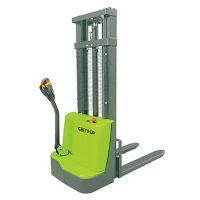
- Scalable Partnership Growth: Several of our largest national distributors started with a single mixed trial order for agricultural or regional retail warehouses and scaled into full-line OEM programs covering electric pallet trucks, stackers, and reach trucks.
Learn more about our 40-year engineering heritage and OEM partner policies on our About Us page.
Evaluating new OEM suppliers for 2026–2027?
Schedule a live 1-on-1 video factory audit with our engineering team to inspect our welding lines and hydraulic testing stations in real time-or request our OEM Private-Label Spec & Tiered Pricing Dossier today.