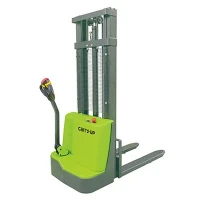

When handling goods, manual pallet trucks frequently navigate through narrow passages involving both straight sections and curves. It is essential to take into account the width of the site's aisles and the forklift's turning radius; only through proper driving techniques can safe and smooth operations be guaranteed.
1. Key Operational Techniques for Driving Manual Pallet Trucks Through Straight and Curved Passages
1.1 Forward Movement. Upon entering the designated area, the manual pallet truck should be positioned as close as possible to the inner boundary line, maintaining a distance of approximately 0.10m between the inner wheels and the inner line while proceeding in a straight, parallel path. When approaching within 1–2m of a right-angle turn, slow down to a crawl.
Once the mast aligns with the turning point, quickly turn the steering wheel to the left (or right) to its full lock position. This allows the forklift's inner front wheel to pivot around the corner; continue turning until the rear wheel is just about to cross the outer boundary line, at which point you should begin to counter-steer (straighten the wheel). Once the steering is centered and aligned with the new direction of travel, proceed forward to complete the maneuver.
1.2 Reverse Movement. When reversing, guide the manual pallet truck so that its rear wheels track along the outer boundary line, thereby leaving a safe clearance path for the front wheels. When the forklift's lateral centerline aligns with the corner point, quickly turn the steering wheel to the left (or right) to its full lock position. As soon as the front wheels have cleared the corner point, immediately counter-steer to straighten and align the vehicle body, then continue reversing.
2. Important Considerations for Driving Manual Pallet Trucks Through Straight and Curved Passages
2.1 Pay special attention to the "outer wheel difference" (the lateral offset of the outer wheels during a turn) to prevent the rear wheels from drifting beyond the boundary lines or striking obstacles.
2.2 During operation, utilize a low gear and proceed at a slow speed. Maintain precise control over your vehicle speed, and pay close attention to the timing and speed of your steering inputs - both when initiating a turn and when counter-steering to straighten the vehicle.
2.3 Whenever possible, drive close to the inner boundary line; steering inputs should be executed swiftly, while remaining vigilant to avoid any scraping or contact with surrounding objects.
2.4 After completing a turn, ensure you promptly return the steering wheel to the straight-ahead position to avoid scraping or colliding with obstacles on the inner side of the path.
Additionally, there are specific operational requirements for handling manual pallet jacks: after starting up, the operator must drive forward - executing a sequence of right, left, left, and right turns - until reaching the designated parking spot. Subsequently, the operator must reverse along the exact same route - executing the reverse sequence of right, left, left, and right turns - to return to the starting position. Throughout the entire maneuver, a steady speed must be maintained, ensuring that there is no scraping, bumping, stalling, or unauthorized stopping.