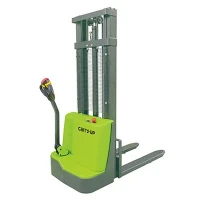

To accommodate diverse operating environments and cargo requirements, manual pallet trucks have evolved into various types, primarily categorized by their function, material, and load capacity.
1. Classification by Function and Structure
- Standard Type: The most universal model, featuring a welded high-quality steel plate frame and an integrally cast hydraulic cylinder; it offers reliable and durable performance.
- Quick-Lift Type: Features an optimized hydraulic system that typically requires only two pump strokes to raise the forks to the base of the pallet. Compared to the standard model, it reduces lifting time by approximately half, thereby boosting operational efficiency.
- Low-Profile Type: Designed with a lower minimum body height, making it suitable for use with low-clearance pallets or in confined workspaces, where it facilitates easier fork insertion.
- Paper Roll/Tube Type: Features a fork design specifically adapted for handling cylindrical loads - such as paper rolls or fabric bolts - in industries like papermaking and textiles.
- Integrated Scale Type: Incorporates a high-precision weighing instrument, allowing for direct weighing of loads during the handling process. With an accuracy of up to 0.1%, it is ideal for warehousing operations that require weight measurement.
- Heavy-Duty Type: Constructed with thickened steel plates and reinforced wheel assemblies, this model boasts a rated load capacity ranging from 2 to 5 tons (or even higher), making it suitable for transporting exceptionally heavy cargo.
2. Classification by Material and Operating Environment
- Galvanized Type: Exposed components - such as the frame and handle - undergo a galvanization process. This provides superior rust resistance, making the unit suitable for use in humid environments.
- Stainless Steel Type: Key components are manufactured using stainless steel materials, offering exceptional corrosion resistance. This type is specifically designed for industries with stringent hygiene and corrosion-resistance requirements, such as food processing, dairy production, pharmaceuticals, and cold storage facilities.
3. Load Capacity and Dimensions
- Common Rated Load Capacities: These typically include 1.0 tons, 2.0 tons, 2.5 tons, 3.0 tons, and 5.0 tons.
- Fork Widths: Primarily available in two standard configurations - the "Narrow Truck" (approx. 540 mm wide) and the "Wide Truck" (approx. 685 mm wide). The appropriate choice should be determined based on the dimensions of the pallets most frequently used in the operation.