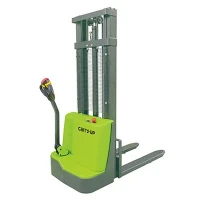

Before purchasing a manual pallet jack, many customers aim to select a model that offers the best value for money and suits their specific needs. Given the wide variety of manual handling equipment currently available on the market, how does one go about choosing a practical and cost-effective pallet jack? To make an informed decision - and to identify a truly high-quality unit - it is essential to gain a thorough understanding of the device's technical parameters by closely examining its key components.
1. Hydraulic Cylinder
The hydraulic cylinder plays a pivotal role in the entire lifting and lowering process of a manual pallet jack; it is the mechanism through which loads are raised and lowered. Therefore, if you encounter a situation where the fork carriage fails to lower or rise, the issue may stem from the following causes:
⑴ Overloading or uneven loading of the cargo, which places excessive stress on the piston rod and cylinder, potentially causing damage to these components.
⑵ Rusting of the piston rod due to prolonged exposure to the elements, which obstructs the smooth movement of the piston.
⑶ Misalignment of the adjustment nut and hexagonal nut. In such cases, a diagnosis is required to determine whether the piston rod or cylinder needs replacement; additionally, when the pallet jack is not in use, the forks should be lowered to their lowest position, and the nuts should be readjusted.
2. Oil Seals
Oil seals are critical components responsible for maintaining a tight seal between the hydraulic cylinder's piston rod and the cylinder barrel. Typically, high-quality imported sealing rings are utilized for this purpose, offering superior sealing performance, wear resistance, and longevity. Notably, approximately 70% of all hydraulic cylinder oil leaks originate from the oil seals. If a leak is detected, an immediate inspection is warranted; should the sealing rings be found to be aged or damaged, they must be replaced with high-quality alternatives.
3. Hydraulic Pump
The hydraulic pump is the single most critical component in any manual pallet jack. If the pump malfunctions, the entire unit effectively ceases to function - rendering the pallet jack inoperable, regardless of how sound or undamaged its other components may be. The hydraulic pump itself comprises a multitude of individual parts; among those most prone to failure are the dust ring, O-rings, and steel balls. Should any of these specific components be found to be defective, worn, or damaged during operation, the simplest and most expedient solution is to replace the affected parts.
4. Lever Frame
The lever frame is a critical component connecting the hydraulic pump to the push rod. It serves as the primary support for the hydraulic cylinder's lifting action and bears the load during cargo handling; it is also essential for maintaining balance during operation. Because manual pallet trucks are susceptible to issues such as overloading or uneven loading during cargo transport, the lever frame is prone to deformation or fracture. Should such damage occur, the pallet truck will be rendered inoperable; therefore, it is necessary to contact the manufacturer or purchase a replacement lever frame from the market.
5. Wheels
The wheels of a manual pallet truck are consumable parts that inevitably undergo wear and tear after prolonged use in transporting cargo. Pallet truck wheels come in various types, including nylon, PU (polyurethane), polyurethane-coated nylon, rubber, and phenolic (Bakelite) wheels. Most manual pallet trucks are equipped with nylon wheels due to their widespread availability and low cost; however, they exhibit relatively poor wear resistance and generate significant noise during movement. Once the wheels have worn down to a certain extent, they should be replaced promptly; customers may choose between higher-end or more economical options according to their preference.