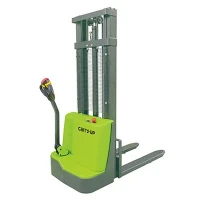

The semi-electric stacker is a new type of stacking machinery characterized by electric lifting capabilities, ease of operation, and eco-friendliness. It is widely utilized for the movement and stacking of elevated cargo and pallets. In numerous settings - such as factories, warehouses, and logistics centers - the use of semi-electric pallet stackers for unitized pallet stacking is both safe and convenient. Furthermore, in specific work environments involving narrow aisles, multi-story floors, or high-bay warehouses, these machines particularly excel in demonstrating their agility, quiet operation, and eco-friendly attributes.
1. Construction
The semi-electric stacker is primarily composed of the following components: a steel mast assembly, a battery, an electric motor, a hydraulic pump station, a piston rod, lifting chains, wheels, and an operating handle.
2. Working Principle
During lifting operations, the semi-electric stacker utilizes a lift control lever to activate the hydraulic pump station. This action directly drives the hydraulic cylinder, inducing relative motion between the inner and outer masts and the carriage assembly, thereby causing the forks to ascend or descend.
3. Drive System
The semi-electric stacker is propelled manually (via human pushing). It is equipped with wheels manufactured using specialized processes - typically made of nylon or polyurethane - which offer excellent wear resistance, load-bearing capacity, and quiet operation. The manual control interface ensures flexible and effortless maneuverability.
4. Steering Operation
The steering handle operates via a steering mechanism that acts upon the two swivel wheels. This design ensures light and agile turning capabilities; consequently, the operator simply needs to rotate the steering handle to the desired angle to execute a turn.
5. Parking Brake
The parking brake is engaged via a foot pedal. This mechanism applies braking force directly to the swivel wheels, providing immediate and effective immobilization of the vehicle.
6. Hydraulic Circuit
To raise or lower the forks, the operator manipulates the hydraulic control lever. This enables the pump station to drive the hydraulic cylinder, facilitating the relative movement of the inner and outer masts and the carriage assembly to raise or lower the forks (specifically, by pulling the hydraulic lever backward). A pressure relief valve is integrated into the hydraulic pump to protect both the vehicle and the hydraulic system in the event of an overload.
7. Electrical Circuit
Power is supplied by a rechargeable battery, with a dedicated display indicating the battery's remaining capacity or voltage level. The system features a low-voltage protection function, providing a clear and intuitive visual indication of the machine's operational status. A key switch controls the entire electrical circuit, while the built-in battery charger is equipped with a changeover relay switch that automatically disconnects the operational power supply during charging, thereby ensuring enhanced safety and reliability. The selected wiring harnesses fully satisfy the operational requirements of the entire electrical circuit. All electrical components have been selected to ensure safety and reliability.
8. Load Chart
The load chart placard affixed to the chassis of the semi-electric stacker indicates the vehicle's load capacity at various lifting heights. To ensure personal safety and prevent damage to the vehicle, overloading is strictly prohibited. Operators are required to strictly adhere to the prescribed operational and maintenance guidelines at all times.