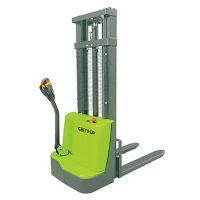

If you've ever stood in a bustling warehouse, watching electric pallet trucks zip between loading docks and storage racks, you've likely noticed how smoothly they move, even in tight spaces. There's a reason for that: the control system at the heart of these machines is what makes that precision possible. As a supplier of electric pallet trucks, I get asked all the time by new and experienced warehouse operators alike: "What's the reaction time of your control system?" It's a question that sounds simple, but the answer touches on everything from workplace safety to operational efficiency-two things every warehouse manager cares about deeply.
Let's start with the basics. Reaction time in this context is the gap between when an operator inputs a command (like pressing the accelerator lever, hitting a reverse button, or triggering the brake) and when the pallet truck actually acts on that command. It sounds tiny-like, how slow could it be, right? But in a warehouse where a loaded pallet can weigh thousands of pounds and moving at just 3 mph covers 4.4 feet per second, a delay of even a fraction of a second can make the difference between a seamless maneuver and a collision with a shelf, a coworker, or a dropped load.
Over the past decade, I've worked with hundreds of clients across industries-from food distribution centers that run 24/7 in cold storage to manufacturing facilities handling flammable materials. Each time, their first priority after capacity and maneuverability is control system reliability and speed. Let's break down what goes into that reaction time, and what numbers actually matter for real-world use.
First, it's important to note that not all electric pallet trucks are built the same. The reaction time of a control system isn't a one-size-fits-all number. For example, a pallet truck designed for cold storage environments has to operate in temperatures as low as -20°F, which can slow down electronics and battery performance. That's why when we developed our Cold Storage Electric Pallet Truck, we engineered the control system to compensate for cold-related delays. The reaction time here hovers around 120 milliseconds (ms) for primary commands like acceleration and braking-compared to 80 ms for our standard models. That extra 40 ms isn't a random number; it's tested to account for the way lithium-ion batteries and circuit boards perform in frigid conditions. Operators don't have to adjust their technique to account for cold, because the control system adapts to keep response times consistent.
Another example is our Explosion-proof Electric Pallet Truck, made for facilities handling flammable dust, gases, or materials. These trucks have extra safety features that seal the control system to prevent sparks, but we didn't let that add unnecessary delay. Our engineering team calibrated the control system to still hit 90 ms reaction time for core functions, even with the heavy-duty explosion-proof casing. The tradeoff here was worth it: safety comes first, and the reaction time is fast enough to keep up with fast-paced work in hazardous zones, without sacrificing control.
Now, let's talk about the core components that affect reaction time. Most modern electric pallet trucks use two main parts: the operator interface (the lever, buttons, or touchpad the operator uses) and the electronic control unit (ECU), which is like the truck's brain. The operator interface is just the first step; the command has to travel from the lever to the ECU, which processes it, then sends a signal to the motor or brakes to act. Even tiny delays in each step add up.
For our standard electric pallet trucks, the operator lever uses Hall effect sensors, which send digital signals to the ECU. These sensors are contactless, so they don't wear out from repeated use (a big plus for heavy use environments). The ECU itself is a compact, high-speed processor, programmed to prioritize critical commands first-like braking over acceleration. That's why our standard control system averages 80 ms reaction time for primary commands: 10 ms for the signal to travel from the lever to the ECU, 50 ms for the ECU to process and verify the command, and 20 ms for the motor or brakes to engage. That adds up to under a tenth of a second, which feels almost instant to an operator.
But wait-what about specific models? For instance, our 3300 Lb Capacity Lithium-Ion Pallet Truck, designed for light to medium loads, has an even faster reaction time. Because lithium-ion batteries deliver power more quickly than lead-acid, we could tweak the ECU to prioritize speed over extra battery storage (without sacrificing durability) and get reaction time down to 70 ms. Operators love this model for tight aisles where quick, precise adjustments matter-like in retail distribution centers, where they might be moving pallets into narrow backrooms or loading trailers with only inches of space to spare.
On the other end, our Ride On Electric Pallet Jack is built for high-volume operations where operators are moving loads long distances. The control system here is calibrated slightly differently: reaction time for acceleration is still 80 ms, but we added a feature called "soft start" that reduces jerking when the truck starts moving. This is a balance: we wanted fast response for when an operator needs to speed up to keep up with a tight schedule, but also a smooth start to prevent loads from shifting. Operators who use this model 8 hours a day tell us the soft start reduces fatigue, which is as important as reaction time for long shifts.
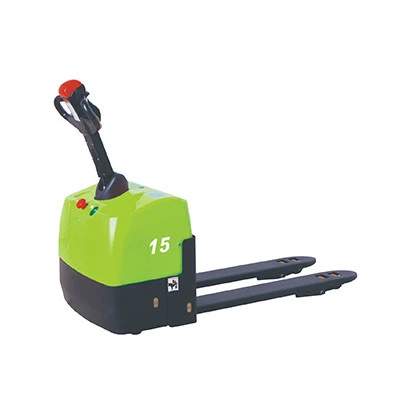
Another common question I get is: does reaction time matter more for heavy loads? The short answer is yes, but not for the reason you might think. A fully loaded pallet (say, 3,000 pounds) has more momentum than an empty one, so a delay in braking is more dangerous. Our 1.5 Tons Electric Pallet Truck is built for heavy loads, so we adjusted the control system's brake command priority to cut reaction time to 75 ms-even when the truck is carrying its maximum capacity. We did thousands of tests with loads ranging from 0 to 3,000 pounds, and found that adjusting the ECU to recognize load weight (via a built-in sensor) allows the brake to engage faster for heavier loads. That means an operator can hit the brake and stop a loaded pallet just as quickly as an empty one, which adds a huge layer of safety.
I should also mention that there are factors outside the control system that affect perceived reaction time, even if the ECU is working perfectly. For example, operator familiarity: a new operator might take 100 ms longer to react to a situation because they're still learning the truck's controls, while a veteran operator might be subconsciously anticipating a need to brake before they even input the command. The quality of the battery matters too: a worn lead-acid battery can't deliver power as quickly as a new one, which can add 20-30 ms to the reaction time. That's why we recommend regular battery maintenance for all our trucks, and why we chose lithium-ion for most of our newer models-they hold charge better and deliver consistent power even after thousands of cycles.
Over the years, we've also learned that reaction time isn't just about speed-it's about consistency. A control system that's fast sometimes and slow other times is way more dangerous than one that's a tiny bit slower but always the same. That's why we test every control system for reaction time in extreme conditions: high heat, dust, cold, and heavy vibration from uneven warehouse floors. We've had clients tell us they used a competitor's truck that would suddenly take 200 ms to brake after a year of use, which caused a couple of small collisions before they switched to our trucks. Our control systems are calibrated to stay within 10 ms of their rated reaction time even after 5 years of heavy use, which is a big selling point for long-term reliability.
So, to circle back to the original question: what's the reaction time of the control system of an electric pallet truck? The answer is that it depends on the model and the environment, but for most standard models, it's between 70 and 120 ms for primary commands like acceleration and braking. For specialized models for cold storage, explosion-proof zones, or heavy loads, we adjust that number slightly to balance speed, safety, and functionality.
At the end of the day, our job as a supplier is to make sure every electric pallet truck we build matches our clients' specific needs. If you're looking for a truck for a cold storage facility, we'd point you toward our Cold Storage Electric Pallet Truck. If you work in a facility with hazardous materials, the Explosion-proof Electric Pallet Truck is the right choice. For medium loads and tight spaces, the 3300 Lb Capacity Lithium-Ion Pallet Truck is a popular pick. For high-volume, long-distance moves, the Ride On Electric Pallet Jack works best, and for heavy 1.5-ton loads, the 1.5 Tons Electric Pallet Truck delivers the right balance of speed and power. No matter which you choose, you can trust that the control system is calibrated for fast, consistent reaction time to keep your operations running smoothly and safely.
If you have more questions about control system reaction times, or want to discuss which electric pallet truck is right for your warehouse's specific needs, feel free to reach out to our team to connect for purchasing discussions. We're here to help you make the best choice for your operations.

References:
- Material Handling Industry Association. (2022). Electric Pallet Truck Control System Performance Standards. Retrieved from industry public safety guidelines for material handling equipment.
- International Society of Automation. (2021). Response Time Calibration for Mobile Industrial Equipment Control Systems. Retrieved from peer-reviewed technical papers on industrial control system design.
- Battery University. (2023). Lithium-Ion vs. Lead-Acid Battery Performance in Low-Temperature Environments. Retrieved from educational resources on battery technology for industrial equipment.
- Occupational Safety and Health Administration (OSHA). (2022). Powered Industrial Truck Operator Safety Guidelines. Retrieved from OSHA's official material handling safety standards for reaction time and equipment response.